

Banner image of a young Alan Watts on Chain Reaction in 1983. All historical climbing images added to Eli’s article courtesy of Mike Volk/SmithRock.com.
Honors Literature Project Becomes Student Guest Post on Smith Rock Sport Climbing History
February 9, 2021
When Eli Olson, a 9th grade Honors Literature student at Estacada High School about 30 miles southeast of Portland contacted us to help him with his final project assignment—To find a way to get my work out into the world, we were moved. He was allowed to write about anything he wanted to, and he chose to write about the history of sport climbing at Smith Rock, where it all began for North America. He originally started his essay last year but didn’t get to finish with the impact of COVID on the school system. By the time he got to pick up his project again, it evolved from the history of climbing in the U.S. that was mainly focused on Yosemite, until he learned about Smith Rock. Now he encourages others to push their boundaries and try sport climbing.
The History of Sport Climbing at Smith Rock
by Eli Olson
Honors Literature, Jordan Collins
Estacada High School
Smith Rock is a state park in central Oregon founded in 1960, now thought to be the birthplace of modern American sport climbing. This park welcomes over 747,000 visitors annually and offers a multitude of activities one of the most popular being rock climbing. Climbers from all over the world challenge themselves to try some of the over 2,000 recognized climbing routes of varying difficulty and length. In this essay, I will share with you the history of sport climbing on Smith Rock, in decades like the 1980s and ’90s, the 2000s, and the future of sport climbing in the Olympics.

Alan Watts on the East Face of Monkey Face in the early 1980s.
The 1980s is when sport climbing started its transition to popularity in Smith Rock State Park. In 1975 Alan Watts began to climb at Smith Rock while he was 14. At this point in time Smith Rock was not considered to be a real place to climb and the rocks were not great, people climbed here to hone their skills so they could climb real routes in the mountains. In the early to mid-1980s Alan Watts put Smith Rock on the international stage, starting up sport climbing in North America at Smith Rock State Park. To do this he repelled down a cliffside and hand-drilled small holes in the cliff, then in those he put a piece of hardware similar to a construction concrete bolt that had a collar on it that expanded and held the bolt in place. These days a mix of glue-in I-bolts and expansion bolts specifically designed for climbing have replaced the earlier hardware.
In the late 1980s, Alan and others continued to create new climbing routes in their new sport climbing style with the introduction of the power drill in 1985 to route bolting. As they created more and more routes top climbers came from all over the world, as well as students from local colleges like OSU began trying these routes and the new style of climbing. As it grew in popularity in rock gyms, the park began to be viewed in different ways. More and more people started to climb this park and as a result, new climbing generations continued to create more and more climbing routes. They designed routes of varying difficulty and style, from overhangs to cracks. The popularity of Smith Rock was growing but still not to where it is today.

Chris Grover bolting Churning in the Wake in 1986

Alan Watts putting up Sheer Trickery on Monkey Face in 1989
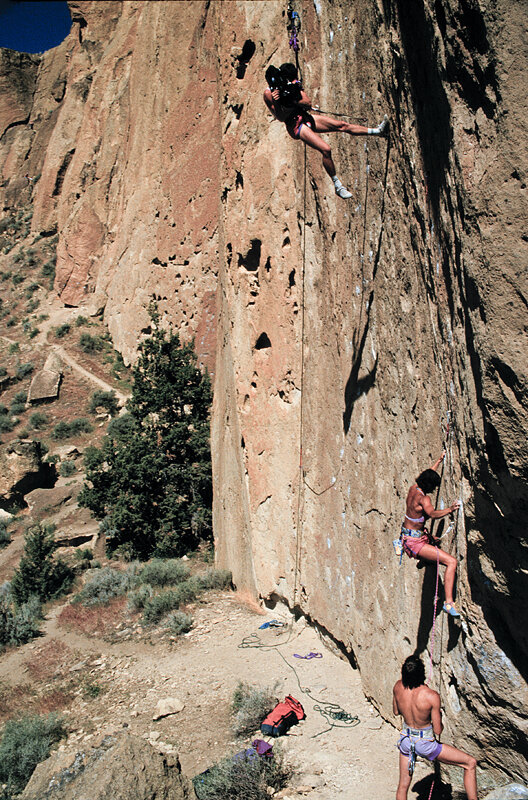
Luisa Iovane, top female Italian climber on Morning Glory Wall being filmed by Heinz Mariacher in 1987

View of the Monument Area the day after the Big Burn at Smith Rock in August 1996
The 1990s marked a new era for Smith Rock. In 1992, Alan Watts published his first complete rock climbing guide book to Smith Rock, (updated in 2010 detailing over 1,700 routes). Watts’ book is extremely helpful and is still the main route guide source used today. Alan said he could only climb rarely after this due to joint problems in his fingers caused by decades of climbing. He said that by this time there were so many routes that not even he had done them all and that no one ever would. There were routes ranging all the way from 5.0 (easy) to 5.15a (the most difficult at the time). With the new range of difficulties younger and more inexperienced climbers could experience Smith Rock which in turn made it more popular. In 1996 Smith Rock suffered a fire caused by sparks from a welder that was making repairs on a campsite, it burned about 200 acres of vegetation, but fortunately, since the climbs are made of rock they were fine. Smith Rock was now extremely popular for climbers of any skill level looking to improve their skills. Smith Rock experienced a transition into mass popularity in the 1990s.
The 2000s brought new things to Smith Rock. In the year 2000, Smith Rock got a website, SmithRock.com, started by Mike Volk, the original owner of Timberline Mountain Guides and Smith Rock Climbing School guides service in 1983. Alan Watts worked as a guide for him, and he credits Mike with making it possible for him to accomplish what he did, by sharing his nearby property as a home base for Alan and climbers from all over the world that came to test themselves on some of the hardest routes for the time. SmithRock.com has grown to over 250 pages today and has all kinds of information about the park for climbers and others who go there. It shows all the 3 and 4 star-rated official climbs by climbing area, as well as has detailed information on hikes, hours, and more. This website was extremely helpful to me because it can teach you about anything in the park, not just climbing. But back to climbing. People continued to climb Smith Rock due to the excellent quality of the rocks and the wide range of climbs. More climbs are added all the time growing the collection of climbs at Smith Rock. While the 2000s may not have been the most monumental for sport climbing on Smith Rock, it did still bring change.
The future for sport climbing at Smith Rock will probably continue as it has for years, with ever-expanding routes and safety upgrades. But sport climbing has grown so much that it was added to Olympics in 2020. Due to the 2020 games not being held because of COVID, sport climbing along with bouldering and speed climbing will be included in the next summer Olympic games, which is set for July 23, 2021. The inclusion of sport climbing in the Olympics will show it to a broader audience and will likely draw more people to the sport, in turn drawing more people to Smith Rock. And more people participating in sports is always good. Since parks reopened during the pandemic this would be a great time for anyone to try rock climbing at Smith Rock even if it's your first time. The future of sport climbing on Smith Rock may be unclear but its inclusion in the Olympics shows that it is growing in popularity.

Topo of Monument Area recent route development courtesy of Mountain Project.
In this essay, I shared with you the history of sport climbing at Smith Rock, in decades like the 1980s and ’90s, the 2000s and the future of sport climbing in the Olympics. Smith Rock started out as nothing more than a state park, that no one thought of as good for climbing. But as Alan Watts and others that followed worked to create new routes and a new style of climbing, they changed the way the park was viewed as well as starting a new type of climbing which is very popular today. Sport climbing is now so popular that it is in the Olympics. So as you have read Smith Rock was the birthplace of modern American sport climbing and is still one of the best places to try it today. Will you push your boundaries and try sport climbing?

Eli Olson at an Order of the Arrow event of the National Society of the Boy Scouts of America at Camp Meriwether
In Eli’s free time he enjoys participating in team sports but chooses to spend most of his time outside in other activities like archery, climbing, and backpacking. Eli is also a Boy Scout and a member of the Order of the Arrow. After high school, he’d like to go to college to be an engineer, or join the Marines as others in his family have done.